The Angles Matter: Dressing the Side Returns of a Bay Window Without a Builder in Sight
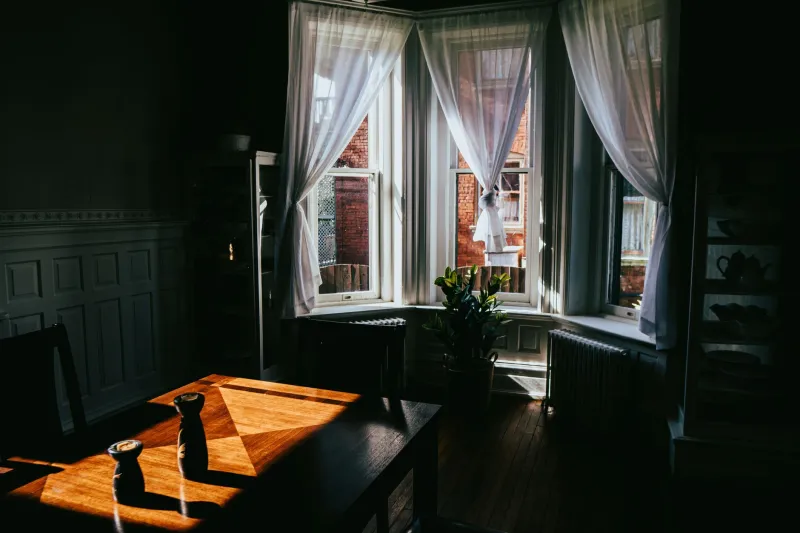
A bay window is supposed to be the star of a UK front room. It pushes the wall out, catches the afternoon light and gives a terraced house a bit of swagger. But stand in the doorway and look again. Nine times out of ten, the central pane has had all the attention. The angled side returns — those narrow panes set at forty-five degrees — are either bare, hidden behind a tired net, or treated like structural afterthoughts. They are the blind spot of the bay.
The good news is that this is a styling problem, not a building problem. You do not need new glazing, a bespoke joinery quote or a builder with a tea habit. You need to decide what each face of the bay is for, then dress the returns with a bit of intent. Here is how to make all three sides feel deliberate without spending a fortune.
Start by giving each face a job
Before you buy anything, spend a week noticing how the bay actually works. Which side gets the morning sun? Which return looks straight at a neighbour’s wheelie bin? Where does the draught land? In a Victorian terrace, the bay may be deeper and darker; in a 1930s semi, the angles might be shallower and brighter; in a modern bay, the returns can feel like narrow slices of glass with no obvious purpose.
Give the central pane the job of view and light. Let the side returns do the quieter work: privacy, softness, screening, a place for a lamp or a plant. Once you stop expecting the returns to behave like the middle, they become much easier to dress. The aim is not to make all three panes identical. It is to make them feel related.
The curtain question: stop at the edge or wrap around?
The classic mistake is a single pair of curtains pulled across the middle of the bay, leaving the angled returns completely exposed. The second classic mistake is a net curtain stretched around every pane, which turns the whole bay into a soft-focus void. Neither feels intentional.
If your budget stretches to a bendy curtain track that follows the bay, that is the cleanest solution. It lets you draw one continuous curtain at night and stack it back during the day. But you do not have to go made-to-measure. For the side returns, slim tension rods inside the window reveal can hold café curtains — the sort that cover the lower half of the glass only. They give privacy from the pavement without blocking the top light, and they look charmingly old-fashioned in a good way. A pair of linen-look café curtains on the returns, left open in the day, instantly stops the bay feeling half-dressed.
If you already have a curtain across the centre, consider adding a simple Roman blind to each return. Keep them in the same family as the main curtain — not necessarily the same fabric, but the same warmth and weight. Avoid heavy pelmets on the angles unless the room is already very tall; they can make the bay feel like a ship’s cabin.
Let a low lamp do the heavy lifting
The side returns are natural corners, and corners love a small pool of light. A slim console table, a narrow shelf or even a sturdy stool can hold a table lamp with a warm bulb. Put it on one return only, not both. Symmetry is not the goal here; balance is.
This is especially useful in November, when the bay is dark by half past four. A low lamp on the side return makes the window feel like part of the room rather than a black rectangle. Choose a shade that sits below eye level when you are standing, so it does not compete with the view. And keep the cable tidy — a loose flex across a windowsill is the quickest way to make a characterful bay look like a student let.
Plants that earn their place
A plant on a side return can soften the hard angle and screen a dull outlook without blocking the central light. But choose the right one. A tall, thin plant — an olive, a rubber plant, a fern if the light is soft — will give vertical interest without spreading across the glass. A trailing plant on a narrow shelf can work, but only if you are prepared to trim it. Nobody wants a bay window that looks like a hedge maze.
Lift the pot off the floor on a simple stand or a stack of old books. It gives the plant presence and stops the corner feeling cluttered. If the return is shallow, use a wall-mounted planter or a small shelf just below the sill. The point is to make the angle feel cared for, not to create a jungle.
Slim shelving, but not across the view
A shallow shelf on the wall flanking the bay — not across the glass — is a good place for a few books, a small vase or a framed postcard. Keep it narrow: deep shelves in a bay will make the whole window feel heavy. If you have a deep windowsill on the returns, use it. A couple of small objects, changed with the seasons, can be enough. A candle in winter, a little posy in summer, a single ceramic bowl in autumn.
The key is restraint. The side returns are not storage. They are architectural features that happen to be very good at holding a lamp, a plant or a small collection of things you actually like.
Seating in the angles
A bay window is a natural place to sit, but the angled returns are awkward for full-sized furniture. Instead of forcing a chair into the corner, try a small upholstered stool, a slim bench or a floor cushion. A window seat would be lovely, but it is not essential. A low stool with a cup of tea and a lamp nearby can make the bay feel like a tiny room of its own.
If you have a radiator under the central pane, leave it alone. Do not box it in or pile cushions against it. The side returns are usually the safer place for a seat, as long as you keep the curtains clear and the radiator’s heat can escape.
The net-curtain void — and how to avoid it
Privacy is the reason most side returns end up covered in net. But net stretched tight across every pane drains the life out of a bay. If you need privacy, use it selectively. Café curtains on the lower half of the returns, a sheer linen that gathers to one side, or even a well-placed plant can do the job without turning the window into a milky haze.
If you rent or cannot drill, tension rods are your friend. They leave no marks and can be moved when you change your mind. The goal is to screen the pavement, not the daylight.
A quick shopping list
You do not need much: two slim tension rods, a pair of café curtains or a simple Roman blind, one small lamp, one plant, a narrow shelf or stool, and a few objects you already own. Charity shops, Dunelm, B&Q and online fabric shops will cover most of it. The transformation comes from putting things on the angles on purpose, not from spending a lot.
Stand back at the end of the day and look at the bay as a whole. The central pane should still feel open. The side returns should feel dressed, not stuffed. If all three faces look like they belong to the same room, you have cracked it. The blind spot is no longer a blind spot — it is part of the view.