Lighting the Long Dark: Five Low-Cost Moves for November Evenings at Home
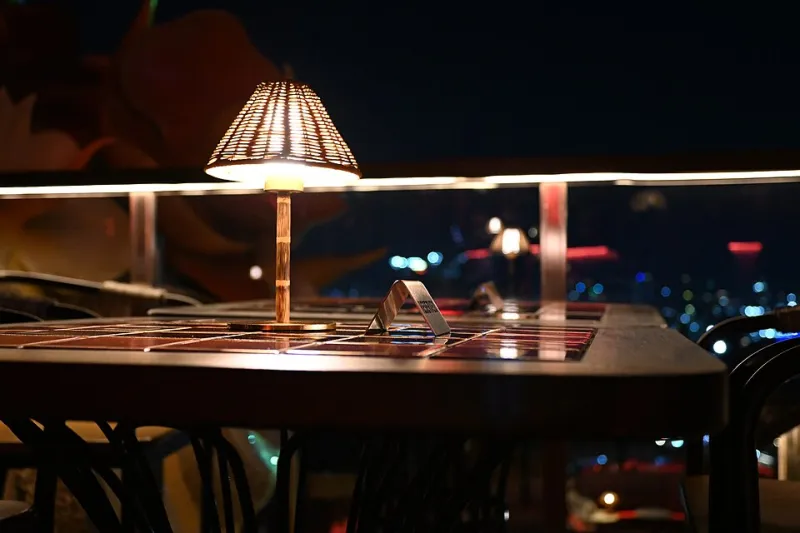
Photo: PattayaPatrol, CC BY-SA 4.0, via Wikimedia Commons
There is a particular hour in November when a well-loved house can suddenly look like a waiting room. The curtains are drawn at half past four, the ceiling light goes on, and every bit of warmth you spent the summer building drains out of the room in about nine seconds.
You do not need an electrician to fix this. You need to stop lighting your home the way you light an office. Here are five moves for the 2026 dark season, all of them cheap, none of them requiring anything more invasive than a screwdriver.
Start with colour temperature, not with lamps
This is the single most common mistake and the easiest to correct. A bulb at 4000K or above is a working bulb: crisp, cool, faintly municipal. Installed in a sitting room at six in the evening it will make even good curtains look grey.
Look for 2700K as your everyday warm white, and 2200K if you want something candle-adjacent for a hallway or a dining room. Check the colour rendering index while you are there, ideally 90 or above, because cheap bulbs with poor rendering make wood look plastic and skin look tired. And buy on lumens rather than the old wattage figures, since a low-lumen bulb is what actually stops a room feeling overlit.
The dim-to-warm bulbs are worth the extra few pounds if you have a fitting you use all evening, as they drop from a warm white to an amber glow as you dim, which is roughly what a filament bulb used to do naturally.
Swap the dimmer, not the wiring
If your dimmer buzzes, flickers or makes LED bulbs strobe unpleasantly, it is probably an old leading-edge unit designed for a time when nobody had LEDs. A trailing-edge LED-compatible dimmer costs somewhere around 20 to 40 pounds and takes fifteen minutes to fit, assuming your wiring is already there and sound. If you are unsure about the wiring, this is a job for an electrician, and it is still a small one.
Why is it the best value in this list? Because dimming changes when a room happens to be lit, not just how bright it is. At 70 per cent, a room is sociable. At 20 per cent, the same room becomes a place to read a novel. That flexibility is what people mistake for good design.
The other free dimmer is the tea towel. Move a table lamp away from a wall and the light spreads; move it closer, and the wall glows. Half of lighting is simply deciding where the falloff should be.
Vertical light flatters architecture, and picture lights are the shortcut
Ceiling light falls flat downwards and makes most period details ironic. Vertical light, washing up or down a wall, makes mouldings, cornices and old brickwork look deliberate. Picture lights are the easiest way to do this without touching the ring main, because rechargeable and plug-in versions are now genuinely decent, with warm LEDs, decent battery life and a magnetic or clip mounting that needs one small screw at most.
Hang the light so the top third of the frame catches the glow rather than the middle, and aim the beam slightly down the wall as well as across the picture. Run the cable down the wall in a slim cover the same colour as the paint if you cannot face the trailing lead.
Change the shade and the room changes with it
Shades are the cheapest mood control in the house. A bare bulb at eye level is a glare problem, however tasteful the fitting; a fabric shade turns that same bulb into a glow. Linen and cotton diffuse softly, and the colour of the fabric sets the whole tone of the room after dark. A warm off-white or oat shade reads calm, and a bit of colour in a hallway shade is a small, brave decision that pays off.
Scale matters more than most people think. A shade should be roughly two-thirds the width of the base under it, and on a wide sideboard a single small lamp looks apologetic. Seek out drum shapes for modern rooms and tapered empire shapes for traditional ones. And if you have a pendant you dislike but cannot change, a large fabric shade can often be fitted over the existing flex with a reducer ring in about four minutes.
Layer low, then lower still
Designers talk about three points of light per room, and it is sound advice, but the more useful rule for November is: no bright light at eye level, and nothing overhead doing all the work. Aim for a pool of light at reading height, a glow at floor level, and something faint near the window to soften the rectangle of dark glass.
A floor uplighter tucked behind a chair is a low-cost way to bring life to a corner. A table lamp on a hall console makes coming home feel less like entering a corridor. A small lamp in a spare bedroom or a bathroom shelf means you stop flicking the big switch entirely.
Two practical notes and then you can get on with the candles. Never run extension leads under rugs, keep fabric shades clear of hot bulbs, and choose the correct maximum wattage, which is still printed inside most fittings. Then put everything, including the fairy lights you are pretending are only for December, on a smart plug or a mechanical timer. Coming home to a house that is already lit is the cheapest character upgrade there is, and in a British November it is very nearly the whole game.