The Loo With a Point of View: Period Nerve in the Smallest Room

Photo: Evelyn Simak, CC BY-SA 2.0, via Wikimedia Commons
The downstairs loo has a strange place in the British home. It is often the smallest room, the least decorated and the most frequently apologised for. Yet it is also the room your guests see at close quarters, usually alone, usually with time to look around. A hallway can be forgiven a pile of shoes. A cloakroom with a loose loo seat, a mirror the size of a postcard and a lonely bottle of hand wash tells a different story.
The good news is that this is exactly the room where period-inspired choices pay off fastest. You do not need to move a soil pipe, chase walls or commit to a full renovation. A downstairs WC is a contained experiment: one window, one door, a few square metres and a limited set of practical demands. Get those right and the room can feel considered, warm and slightly braver than the rest of the house.
Start with the room you have, not the one on Pinterest
Before choosing paint or panelling, spend ten minutes with a tape measure and a critical eye. Note where the soil pipe is boxed in, how the door swings, where the radiator sits and whether the window opens. Check that the extractor fan works. A small room cannot absorb clutter, and no amount of expensive paint will fix a fan that sounds like a leaf blower.
Look for existing character, too. Original tiles under vinyl, a deep skirting, a tiny high window, a ledge where the cistern boxing meets the wall. These are the details worth keeping. If the room is a plain 1990s box, that is fine — it simply means the character has to be added on purpose.
Panelling is the quickest route to period nerve
Tongue-and-groove panelling is the workhorse of the small cloakroom. Run it to dado height around the room, or take it full height on one wall for a more confident look. Moisture-resistant MDF is widely available and can be painted in an eggshell or dedicated bathroom paint. It hides imperfect walls, gives the eye something to read and makes a basin look as if it belongs.
The trick is not to panel every surface. In a tight room, one strong wall is usually enough. Paint the panelling and the wall above it in the same colour to stop the room feeling chopped in half. This is also the place to try a deeper shade — a muddy green, a soft oxblood, a chalky blue — because a small room can carry a dark colour far better than a large one. Buy sample pots and look at them at different times of day.
Give the basin a bit of presence
Most builder-grade cloakroom basins are small, white and apologetic. You do not need to reroute the waste pipe to improve matters. Choose a basin that fits the existing pipework but has more presence: a classic rectangular shape, a console basin with visible legs, or a reclaimed basin from a salvage yard if you can find one with sensible dimensions.
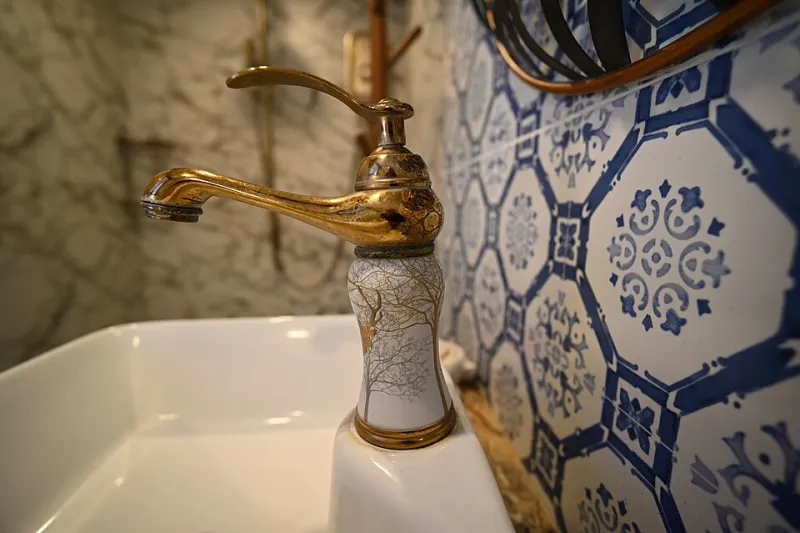
Taps matter more than they should. Cross-head taps in brass or chrome immediately suggest an older building, even if the basin is new. Check the spout reach before buying — a short spout over a shallow basin is a recipe for wet sleeves. If you are keeping the existing basin, a new tap and a proper trap cover can be enough.
Treat the mirror as the room's second window
In a room with one small window, the mirror is doing architectural work. It bounces light, adds depth and gives guests somewhere to check themselves. A vintage mirror with a gilt or painted frame can be picked up for very little, provided it is secure. In a cloakroom, safety matters: use proper fixings and avoid anything too heavy above a basin.
Hang it at eye level for the average adult, not at the height of the previous owner. If the ceiling is low, a taller mirror can make the room feel more generous. If the room is very narrow, a wide mirror over the basin will do more than a small round one.
Light it like a room, not a cupboard
The default cloakroom light is a harsh ceiling fitting that makes everyone look unwell. Swap it for a warm white bulb, ideally around 2700K, and add a wall light beside the mirror if the wiring allows. A dimmer is not essential, but a softer light is. Keep the extractor fan on a timer and make sure it is not blocked by panelling or shelving.
If you cannot add wiring, a rechargeable wall light or a plug-in picture light can work, but check it is suitable for a bathroom zone. Do not put a standard lamp where it can be splashed.
Storage should be quiet, not absent
Small rooms need storage, but it should disappear. A narrow shelf above the door, a slim wall cabinet, a basket under the basin or a lidded box on the cistern boxing can hold spare loo roll and cleaning products. A guest tray with hand soap, a folded towel and a small bin is enough. Resist the urge to display every scent and ornament — this is a room, not a shelf.
Finish the edges
The details that make a period room feel settled are often the least expensive: a decent skirting board, a painted door in the same colour as the walls, a proper handle, a small runner or a washable mat. If the floor is original tile, keep it. If it is vinyl, choose something plain and warm underfoot. A cloakroom is not the place for a busy pattern unless the rest of the room is very quiet.
The point of the smallest room
A downstairs loo is a low-stakes place to test a bolder period choice. You can paint it dark, panel it, hang a slightly mad mirror and see how it feels. If it does not work, you have lost a weekend and a tin of paint, not a kitchen. That is the charm of the room: it asks for nerve rather than a builder.
Get the practicalities right — extractor, pipework, moisture-resistant finishes — and then let the room have a point of view. Guests may not remember your hallway, but they will remember a cloakroom that feels as if someone thought about it. And in a house that is trying to be characterful without a full renovation, that is a very good place to start.