Six Feet by Nine: What a Box Room Becomes When You Stop Calling It Storage
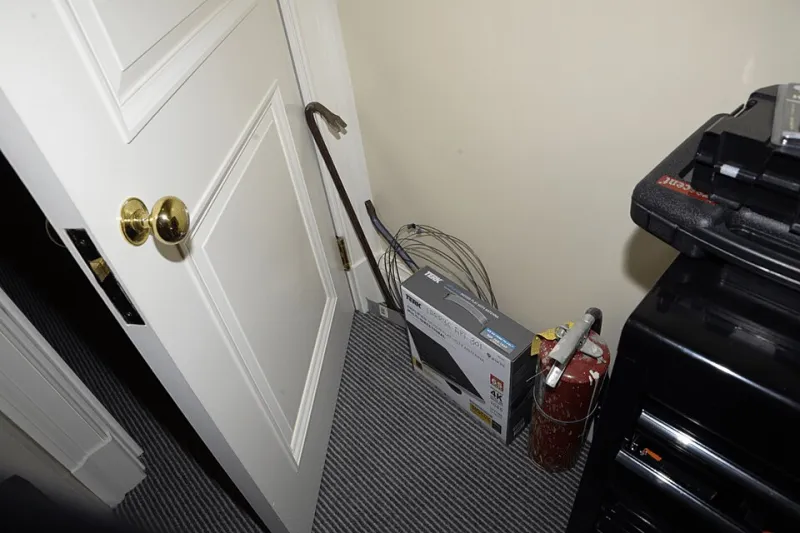
Photo: Federal Bureau of Investigation, Public domain, via Wikimedia Commons
Every house has one. Up the stairs, past the bathroom, turn left at the airing cupboard, and there it is: roughly six feet by nine, one window, one radiator, and a door that has clearly never been fully openable. In the estate agent's particulars it was a "third bedroom". In real life it has spent the last three years as a suitcase park, a drying rack annexe and the place where the Christmas decorations go to be forgotten.
The box room gets a rough deal in this country. We treat it as a temporary state of affairs, a room waiting for a loft conversion or a savings pot that never quite fills. But a small room with a clear purpose is worth more than a big room with none. It doesn't need knocking through, extending or re-plumbing. It needs a decision, a tape measure, and about a weekend's worth of effort.
Start with the job, not the furniture
The mistake almost everyone makes is buying furniture first and hoping a purpose turns up. Reverse it. Sit on the floor of the empty room, look at where the light falls, and ask what this house is actually short of.
A proper single bedroom for a child who currently shares. A study that isn't the kitchen table. A room for a parent who visits four times a year and deserves better than the sofa. A dressing room, if the main bedroom is a squeeze. A place for the sewing machine, the guitar, the trainer collection, the paperwork that has no home.
The rule is one job, clearly stated. "Guest room and study and storage" is how box rooms end up as neither. If it must do two things, let one be the everyday job and the other the occasional one — a desk that gets used daily and a chair-bed that gets unfolded at Christmas is a workable pairing. A permanent double bed in a six-by-nine room is not; it will eat the floor and leave you nowhere to stand while you make it.
Measure like you mean it
Before anything gets ordered, get a proper drawing. Not a sketch on the back of an envelope — an actual plan with dimensions, including the things people forget: how far the door swings, where the radiator sits and how tall it is, the depth of the window reveal, the height of the skirting, the position of every socket and light switch.
Those details decide the layout. A door that opens inward against the longest wall can rule out the obvious bed position outright. A radiator under the window means you can't push a desk flush to the wall without cooking your knees. A deep reveal, though, is a gift — it will take a shelf, and a shelf takes a lamp, a plant and the book you're pretending to read.
Beds that respect the floor
Narrow singles start around 75cm and go up to the standard 90cm. If the room is for occasional use, a small double is tempting and usually a mistake; two people in a box room is a negotiation, not a night's sleep. A 90cm single with a decent headboard will do more for the room than a cramped 120cm.
Height is your friend if the ceiling allows it. A high sleeper over a desk reclaims the whole footprint, but check headroom above the mattress and make sure nobody is climbing down in the dark next to a window. Cabin beds with storage underneath are a middle path. so are divans with drawers, though drawers need clear floor to pull into — measure that swing too.
Daybeds and chair-beds suit a room that is a study most of the year. Just be honest about how often it will actually be unfolded. If the answer is twice a decade, a really good armchair and a decent airbed might be the more truthful purchase.
Desks that don't swallow the room
Standard desks are 60cm deep because offices have space. A box room doesn't. Look for 40–45cm depth — enough for a laptop, a notebook and a mug, which is what most of us actually use. A wall-mounted shelf at desk height with brackets beneath does the same job for less, and leaves the floor visually clear.
If the window reveal is deep enough, a length of timber cut to fit makes a beautiful desk and costs very little. It also puts you side-on to the light rather than squinting into it.
Paint, light and the art of not shouting
Small rooms feel smaller when they're busy. A single colour across walls, ceiling and woodwork — or something very close — blurs the edges of the room and makes the ceiling feel further away than it is. That doesn't have to mean white. A soft green, a chalky off-white, a muted clay: all of them work, as long as the ceiling joins in rather than sitting above like a lid.
Lighting, though, is where most box rooms give themselves away. One pendant in the centre of the ceiling casts a hard pool of light and leaves the corners gloomy, which is exactly what makes a room read as an afterthought. Swap the shade for something that throws light upward as well as down, and add a small lamp on the shelf or a plug-in wall light beside the bed. Two soft sources beat one bright one every time.
Work with the door, the window and the trim
This is the part people skip, and it's the part that makes the difference. If the room still has its original four-panel door, keep it. A hollow flush door in a 1930s terrace is a small tragedy, and swapping one back costs less than most people assume.
Painting the skirting, architrave and door the same colour as the walls is the quietest trick in small-room styling — it removes the visual noise of white outlines boxing everything in. If the rest of the house has crisp white woodwork and you want continuity, keep it, but let the walls do the work instead.
And leave the window alone. Don't box it in, don't add a pelmet that eats the light, don't hang curtains so heavy they need their own postcode. A simple roman blind or a pair of slim curtains on a track close to the ceiling will do. The reveal stays visible, the room stays taller, and the original proportions get to speak.
The last ten per cent
Hooks on the back of the door. A shallow shelf above the door frame. A mirror opposite the window, if there's a wall for it. One piece of art, hung at eye level, rather than five small ones scattered to fill space.
None of this is expensive. What it is, is deliberate — and deliberateness is what a box room has been missing. Give the smallest room in the house one clear job and a bit of care, and it will stop being the place where things go to wait. It'll be the room you didn't know you needed.